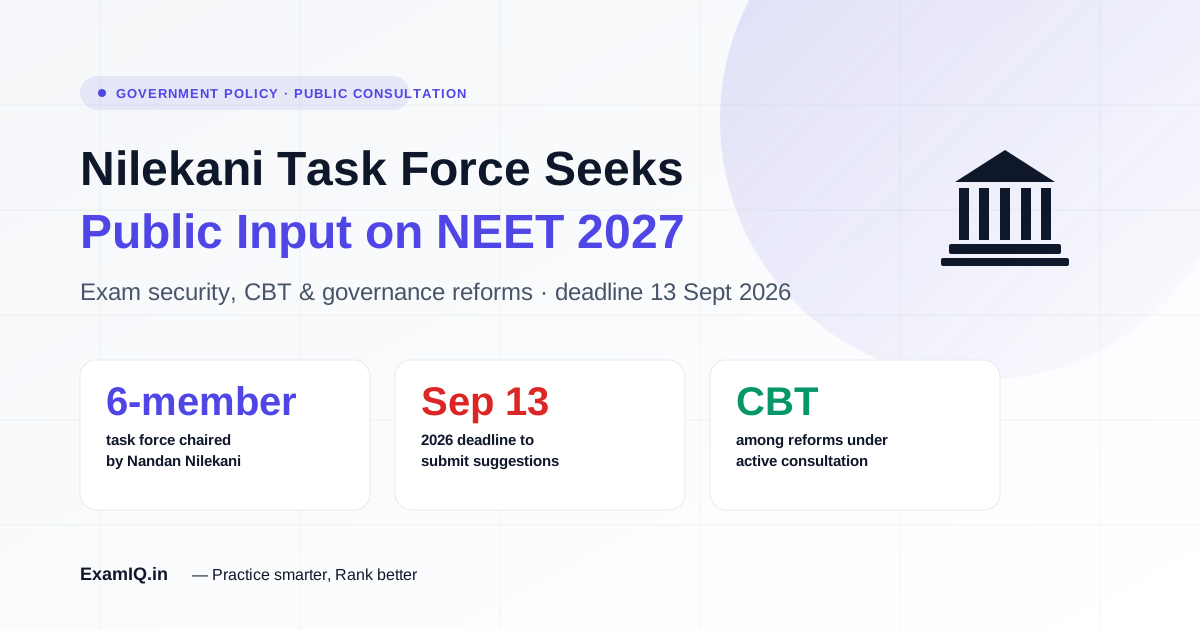
The Government of India has opened a public consultation on reforms to India's public examination system, including examinations conducted by the National Testing Agency (NTA).
The consultation is being led by a High-Powered Task Force (HPTF) chaired by Nandan Nilekani, and it could have major implications for the future of national entrance examinations such as NEET UG 2027.
The task force is seeking suggestions on examination security, technology, computer-based testing, infrastructure, governance, grievance redressal, accessibility and student well-being.
For NEET 2027 aspirants, this is particularly important because the examination system is undergoing a significant review following the problems surrounding NEET UG 2026.
What Is the Nandan Nilekani Task Force?
The Government constituted a six-member High-Powered Task Force on examination reforms, chaired by Nandan Nilekani.
The task force has been asked to examine comprehensive reforms covering the:
- Conduct of public examinations
- Security of examinations
- Examination design
- Assessment methodology
- Governance and accountability
- Use of technology
- Examination infrastructure
- Prevention of examination malpractice
- Candidate grievance redressal
- Accessibility and inclusion
- Student well-being
The broader objective is to create a public examination system that is secure, transparent, equitable and future-ready.
The task force was constituted amid concerns about the integrity and administration of major national examinations, including the NTA's handling of NEET-related controversies.
Why Is This Important for NEET 2027?
NEET UG is one of India's largest entrance examinations, with millions of students competing for medical seats.
The examination has traditionally relied on a large-scale pen-and-paper and OMR-based system. However, the government is now examining whether technology can make national examinations more secure, scalable and transparent.
The task force's consultation specifically includes secure Computer-Based Testing (CBT) and the expansion of examination infrastructure. This makes the reform exercise highly relevant to the ongoing discussion around NEET 2027 CBT.
However, one important distinction needs to be made: CBT is being actively considered as part of the reform process, but aspirants should wait for the official NEET 2027 Information Bulletin for the final examination format and operational rules.
What Changes Could NEET 2027 Potentially See?
The task force has not yet published its final recommendations. Therefore, the following should be viewed as areas under consideration rather than confirmed NEET 2027 rules.
1. Computer-Based Testing
One of the most important areas being examined is the use of secure computer-based testing. A CBT-based NEET could potentially provide advantages such as:
- Digital question delivery
- Reduced physical question-paper movement
- Stronger digital monitoring
- Faster examination logistics
- Greater control over question-paper security
Recent reporting suggests that a multi-day, multi-shift CBT model similar to JEE Main is being examined for NEET, although this is not yet an officially notified NEET 2027 format.
For aspirants, this is an important development — but not a reason to panic.
2. Stronger Question-Paper Security
The examination-reform exercise is also focused on preventing paper leaks and examination malpractice. This could involve stronger controls across the entire examination chain:
Question creation → review → translation → printing/digital preparation → transportation → examination centre → candidate authentication.
The NTA has separately stated that it is implementing broader institutional reforms involving question-paper security, technology-enabled safeguards, biometric authentication, secure infrastructure and monitoring.
For NEET 2027 candidates, this could mean significantly tighter examination-centre procedures.
3. Better Examination Infrastructure
Large-scale CBT examinations require substantial infrastructure. The task force is therefore examining ways to create and augment examination infrastructure, including the availability of secure testing centres.
This is one of the biggest practical challenges in shifting an examination as large as NEET to a computer-based format. A successful CBT transition would require:
- Adequate computers
- Reliable power supply
- Backup systems
- Stable networks
- Secure servers
- Trained examination staff
- Candidate authentication
- Technical support
- Contingency arrangements
The objective isn't simply to put the existing NEET paper on a computer. The entire examination ecosystem would need to support millions of candidates.
4. Stronger Candidate Authentication
Technology may also play a greater role in verifying candidates. Potential areas include:
- Biometric authentication
- Face authentication
- Digital attendance
- Identity verification
- Secure candidate login
- Real-time monitoring
These measures are consistent with the broader direction of NTA's institutional reform programme, which includes biometric authentication and technology-enabled examination safeguards. For students, this could mean more rigorous verification at examination centres.
5. Better Grievance Redressal
Another important area of the consultation is transparency and grievance redressal. This matters because examination disputes can have serious consequences for students.
A stronger system could provide clearer mechanisms for candidates to:
- Report technical problems
- Challenge examination irregularities
- Raise OMR/response-sheet concerns
- Track complaints
- Receive timely communication
- Understand how grievances are resolved
The task force has specifically invited suggestions relating to transparency, grievance redressal and communication with candidates.
6. Student Well-Being Is Also Part of the Reform
Interestingly, the task force is not focusing exclusively on technology and security. It is also seeking suggestions on student well-being throughout the examination process. This could eventually lead to greater attention being paid to:
- Exam-day stress
- Accessibility
- Communication
- Candidate support
- Grievance handling
- Exam-centre experience
For an examination as high-stakes as NEET, these factors can directly influence a student's performance.
Is NEET 2027 Definitely Going to Be a CBT Exam?
The final answer should come from the official NEET 2027 notification — not rumours.
There has been significant discussion about shifting NEET to CBT, and recent reporting indicates that a multi-day, multi-shift CBT system is being examined as a possible model. However, the task force is still in the recommendation stage.
The current public consultation itself specifically asks for suggestions regarding secure CBT, which confirms that technology-based testing is an important part of the reform discussion.
But students should not assume that details such as:
- Number of shifts
- Number of examination days
- Normalisation formula
- Exact CBT interface
- Exam duration
- Question navigation
- Technical contingency procedures
have already been finalized.
The safest approach: prepare academically as usual, while becoming comfortable with CBT.
What Should NEET 2027 Aspirants Do Right Now?
The good news is that your core preparation does not need to change. Your priority should remain:
NCERT → Concepts → MCQs → Mock Tests → Error Analysis → Revision
However, you can add one more layer — CBT familiarisation. Start taking occasional computer-based tests. You don't need to abandon paper-based practice. Instead, use a balanced approach:
- 80–90%: Regular NEET preparation
- 10–20%: CBT practice
This gives you flexibility while the examination format is being finalized.
How to Prepare for a Possible NEET CBT
If you're preparing for NEET 2027, start developing these skills:
1. Read questions on a screen
Long Biology questions can feel different on a computer compared with paper.
2. Practise question navigation
Become comfortable with next question, previous question, mark for review, answer selection and changing an answer.
3. Practise timed tests
Use a visible countdown timer.
4. Analyse digital fatigue
Take longer tests on a computer and see whether concentration drops toward the end.
5. Practise Physics calculations digitally
If CBT is adopted, you'll need to become comfortable reading numerical problems and solving them while using a computer-based interface.
Public Consultation: Who Can Submit Suggestions?
The consultation isn't limited to government officials or education experts. The task force has invited suggestions from:
- Students and candidates
- Parents
- Teachers
- Academic institutions
- Examination bodies
- Subject experts
- Technology professionals
- Industry organisations
- Civil society organisations
- Other interested stakeholders
The consultation covers examination security, technology, infrastructure, governance, accessibility, grievance redressal and student well-being.
NEET 2027 Aspirants Can Also Make Their Voice Heard
The Government has opened the consultation until 13 September 2026. The government has stated that inputs received through the consultation will assist the task force in formulating its recommendations.
How to Submit Your Suggestions
- Online portal: examreforms-taskforce.dopt.gov.in
- Toll-free helpline: 1800-180-4747
- WhatsApp: Send "hptf" to +91 78270 42830
- Email: ExamReformsTaskforce@dopt.gov.in
The consultation is open in English, Hindi and regional languages, so you can submit your suggestions in the language you're most comfortable with.
This is particularly significant because students are directly affected by any changes to the examination system.
If you have experienced problems with examination centres, OMR handling, question-paper security, candidate verification, technical infrastructure, grievance resolution or exam-day communication, this consultation provides an opportunity for those concerns to be considered as part of the reform process.
What Could the Final NEET 2027 System Look Like?
It is too early to give a definitive answer. However, the current reform discussions point toward an examination system with potentially greater emphasis on technology, security, infrastructure, transparency and accountability.
A possible future NEET ecosystem could therefore look like:
- Secure question creation
- Digital/secure question delivery
- Strong candidate authentication
- Technology-enabled examination centre
- Real-time monitoring
- Secure data processing
- Transparent result and grievance system
The exact implementation will depend on the recommendations of the task force and subsequent government/NTA decisions.
Why the October 2026 Timeline Matters
Recent reporting indicates that the task force is working toward completing consultations around mid-September, with recommendations expected sufficiently ahead of the end-of-October deadline to allow the government time to implement reforms for the 2027 examination cycle. This makes the next few months particularly important for NEET 2027 aspirants.
Important timeline
- August 2026 — Public consultation begins
- 13 September 2026 — Deadline for stakeholder suggestions
- September–October 2026 — Expected task-force recommendations and government consideration
- NEET 2027 cycle — Potential implementation of approved reforms
These dates should be viewed as the reform process timeline, not as confirmed NEET 2027 examination dates.
Frequently Asked Questions
What is the Nandan Nilekani task force?
It is a six-member High-Powered Task Force established by the Government of India to recommend comprehensive reforms in the conduct, security, design and governance of public examinations, including NTA examinations.
Will NEET 2027 be conducted online?
A Computer-Based Test is being actively considered as part of the examination reform process. However, students should wait for the official NEET 2027 notification for confirmation of the final format and operational details.
When is the deadline to submit suggestions to the task force?
The current public consultation is open until 13 September 2026.
Will the NEET 2027 syllabus change because of these reforms?
The task force's mandate concerns the examination system, including security, design, governance and technology. It does not automatically mean that the NEET syllabus will change. Any syllabus change should be considered official only when announced by the competent authorities.
Should NEET 2027 aspirants start preparing for CBT?
Yes — but as a supplementary skill rather than replacing normal preparation. Regular CBT practice can help you become comfortable with screen-based question solving while the final examination format is being determined.
Final Takeaway for NEET 2027 Aspirants
The Nandan Nilekani-led examination reform exercise is potentially one of the most important developments for NEET 2027.
For the first time, the government is seeking direct inputs from students, parents, teachers and other stakeholders on how India's examination system should evolve. The consultation covers much more than CBT — it includes exam security, technology, infrastructure, governance, accessibility, grievance redressal and student well-being.
For NEET 2027 aspirants, the smartest response is not panic. It is adaptability.
Keep your academic preparation unchanged: NCERT + Concepts + MCQs + Revision + Mock Tests
And add: CBT Familiarisation + Digital Test Practice
The final NEET 2027 rules will come through official notifications. Until then, don't let rumours about shifts, normalisation, syllabus changes or eligibility distract you from the one thing you can control: your preparation.
The examination system may change. Your preparation discipline shouldn't.