Six months is enough time to crack NEET — if you use them correctly. Most students who fail don't fail because of knowledge gaps. They fail because of poor strategy: too much time on low-yield chapters, not enough mock tests, and revision cycles that start too late.
This guide gives you a realistic, week-by-week plan built around how NEET is actually marked.
Before You Start: Know Your Numbers
NEET 2027 is 720 marks. Government MBBS admission typically requires 600+ in most states. That means you need ~83% accuracy across 180 questions.
Breaking it down by subject:
| Subject | Total Marks | Target Score (83%) | |---|---|---| | Physics | 180 | 150 | | Chemistry | 180 | 150 | | Biology | 360 | 300 |
Biology has twice the marks of Physics or Chemistry. If you're starting fresh and have 6 months, Biology is your highest ROI investment.
Month 1–2: Foundation Phase
Goal: Complete the full NCERT syllabus once
This is not speed-reading. This is careful, deliberate coverage of every NCERT chapter with active recall.
Daily schedule:
- 6 hours of study per day (minimum)
- 3 hours Biology + 2 hours Chemistry + 1 hour Physics
- Last 30 minutes: revise that day's topics using flashcards or handwritten notes
Week-by-week syllabus:
| Week | Biology | Chemistry | Physics | |---|---|---|---| | 1 | Cell Biology, Biomolecules | Some Basic Concepts, Structure of Atom | Physical World, Kinematics | | 2 | Cell Division, Plant Morphology | Periodic Table, Chemical Bonding | Laws of Motion, Work & Energy | | 3 | Plant Anatomy, Transport in Plants | States of Matter, Thermodynamics | Gravitation, Bulk Matter | | 4 | Mineral Nutrition, Photosynthesis | Equilibrium, Redox Reactions | Thermodynamics, Oscillations | | 5 | Respiration, Plant Growth | s-Block, p-Block Elements | Waves, Electrostatics | | 6 | Animal Kingdom, Anatomy | Organic Chemistry Basics, Hydrocarbons | Current Electricity, Magnetism | | 7 | Human Physiology Part 1 | Haloalkanes, Alcohols, Aldehydes | Electromagnetic Induction | | 8 | Human Physiology Part 2 | Coordination Compounds, Electrochemistry | Optics, Dual Nature |
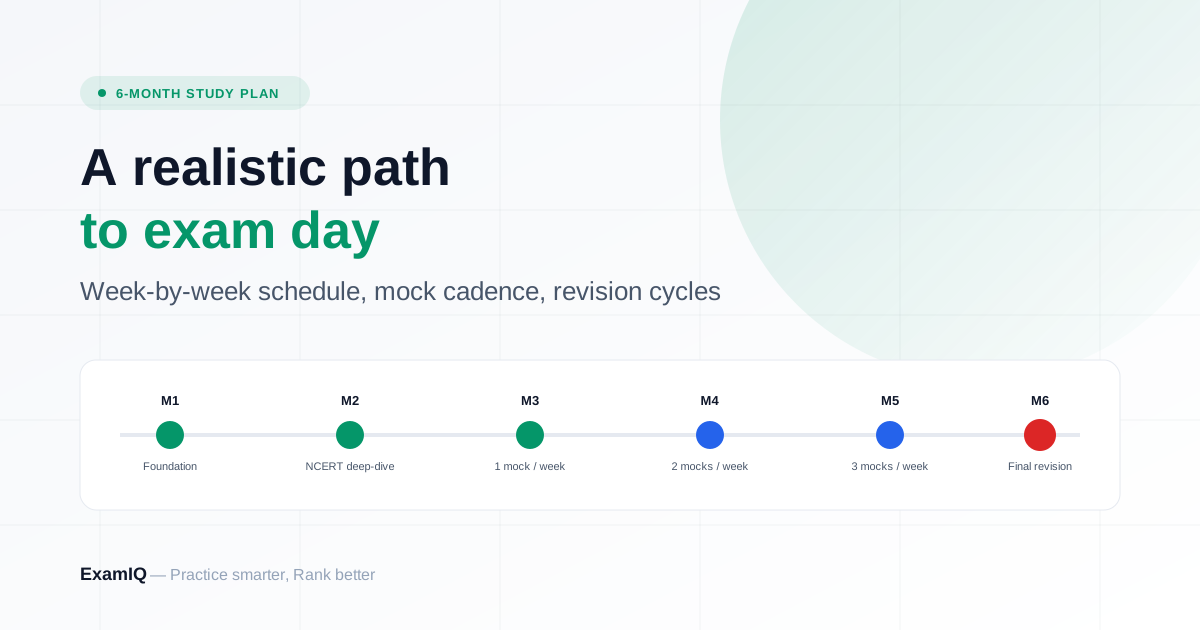
Mock test cadence: 1 full mock every 2 weeks during this phase. Don't skip them. Even if you haven't finished the syllabus, a mock test shows you the pattern.
Month 3–4: Practice Phase
Goal: 40–50 chapter-specific MCQs per chapter, fix weak areas
Now that you have a full cycle done, shift to intensive question practice. For every chapter, solve:
- 30 NCERT-based questions
- 20 previous year NEET questions (PYQs)
- 10 application-level questions
Error log rule: When you get a question wrong, write the concept it tested in your error log. After every 200 questions, review your error log and identify patterns.
Common error patterns:
- If you keep getting Genetics questions wrong → revisit Mendelian laws and molecular biology diagrams
- If Organic Chemistry reactions confuse you → make a reactions flowchart and memorise it
- If Physics numericals take too long → you're not using formulae fluently; more speed drills needed
Mock test cadence: 1 full mock every week. After each mock:
- Score your paper immediately
- Review every wrong answer the same day
- Note the chapter for each mistake
- Don't move on until you understand why you got it wrong
Month 5: Acceleration Phase
Goal: 2 mocks per week, shrink weak areas
By Month 5, your mock test percentile should be rising. If it isn't, you're not reviewing mocks deeply enough.
Two-mock-per-week structure:
- Mock 1 (Sunday): Full-length, 200 minutes, exam conditions
- Mock 2 (Thursday): Subject-specific test (e.g., only Biology) for targeted practice
After each mock, calculate:
- Your subject-wise accuracy (%)
- Your time-per-question average
- Number of attempted questions vs optimal (you should attempt 155+ of 180)
The 80% rule: If your accuracy in any chapter drops below 80%, it gets re-added to your daily revision schedule. No exceptions.
Month 6: Revision & Peak Performance
Goal: Enter exam at maximum confidence
Week 1–2 of Month 6:
- No new topics. Only revision.
- Revise NCERT Biology daily (it's 65% of the Biology paper)
- Revise formula sheet and reaction mechanisms daily
Week 3 of Month 6:
- 3 full mocks in 7 days
- Analyse time management: most students lose 10–15 marks just from poor time allocation
- Practice starting with Biology (highest marks), then Chemistry (most predictable), ending with Physics (most variable)
Week 4 (Final Week):
- 1 mock on Day 1 of the week for calibration
- Day 2–5: Light revision only. High-weightage chapters, your personal error log
- Day 6: Relax. No heavy study.
- Day 7 (Exam): Sleep well. Eat well. Trust your preparation.
What to Do Differently in NEET CBT 2026
Since NEET 2027 is fully computer-based, your mock test practice must also be on a CBT interface. Practicing on paper and then switching to a computer screen on exam day costs you 10–20 minutes of adjustment time.
Practise on ExamIQ's NTA-accurate interface:
- Same colour-coded question palette
- Same Mark for Review / Save & Next buttons
- Live 200-minute countdown
- Instant scoring and subject-wise analysis
The Truth About "Toppers"
Students who score 680+ don't have superhuman knowledge. They have three things:
- Complete NCERT coverage — not a single line skipped
- 50+ mock tests — CBT interface fully internalised, time management perfected
- Brutal error analysis — they didn't just solve mocks, they learned from every mistake
Start today. Six months of consistent, strategic preparation is all you need.