Biology accounts for 90 out of 180 questions in NEET — and 360 out of 720 marks. Your Biology score is the single biggest lever on your final rank. Cracking Biology means cracking NEET.
But with 38 Botany and Zoology chapters across Class 11 and 12, you can't treat every chapter equally. This guide breaks down which chapters to prioritise, backed by actual NEET question data from 2018 to 2024.
NEET Biology — The Big Picture
- Total questions: 90 (Botany 45 + Zoology 45)
- Total marks: 360
- Sections: Section A (35 per subject, compulsory) + Section B (15 per subject, attempt 10)
- Difficulty distribution: ~40% easy, ~45% moderate, ~15% difficult
The good news: Biology has the highest scoring potential in NEET. Strong Biology students regularly score 320–350/360, which makes up for any shortfall in Physics.
High Priority Chapters — Botany
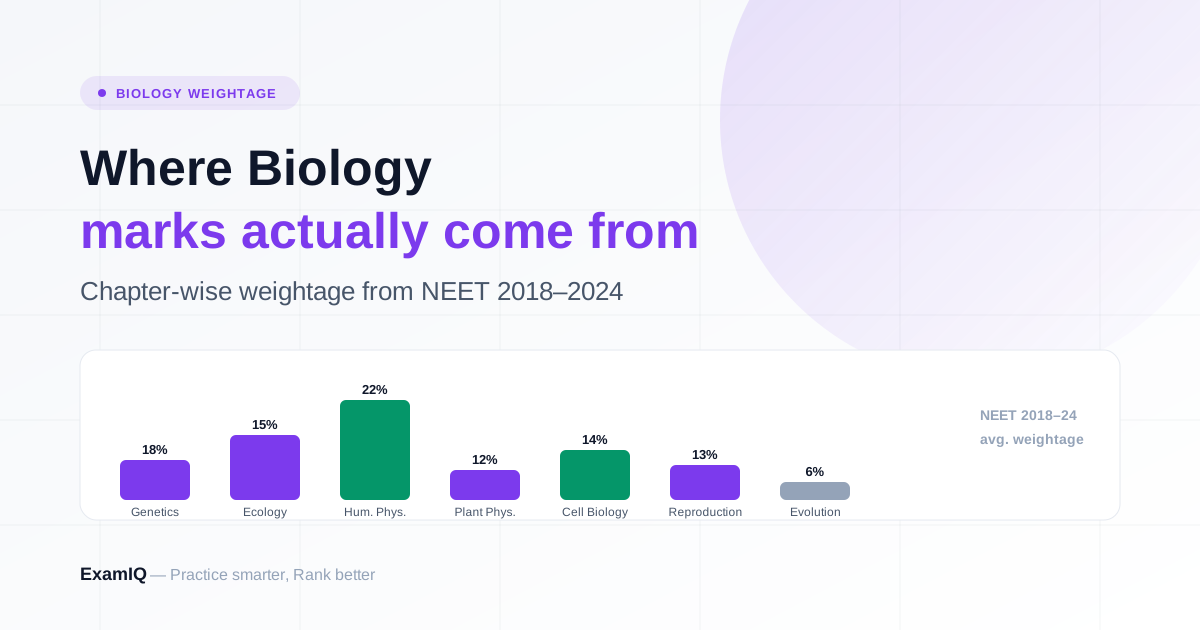
1. Genetics & Evolution (15–18 questions per year)
Consistently the highest-yielding Botany chapter group. Questions come from Mendelian Genetics, Chromosomal theory, Molecular basis of inheritance, and Evolution every single year.
Key topics: Mendel's laws, Dihybrid cross, Linkage, DNA replication, Transcription, Translation, Hardy-Weinberg principle, Evidences of evolution.
Why it's important: 3–4 conceptual questions from Molecular Basis alone. Many can be solved if you understand the mechanism deeply rather than memorising.
2. Plant Physiology (10–12 questions)
Photosynthesis and Respiration together account for 8–10 questions annually. C3 vs C4 pathways, light reactions, cyclic vs non-cyclic photophosphorylation — these are asked every year in some form.
Key topics: Light reactions, Calvin cycle, C4 pathway, Photorespiration, Aerobic respiration, ATP yield calculations, Plant growth regulators.
3. Cell Biology & Cell Division (8–10 questions)
Cell structure, cell organelles, and mitosis/meiosis are reliable scoring topics with predictable question patterns.
Key topics: Cell organelle functions, Plasma membrane models, Cell cycle checkpoints, Stages of mitosis and meiosis, Significance of meiosis.
4. Plant Kingdom (6–8 questions)
Classification, life cycles, and alternation of generations from algae to gymnosperms. Diagrams are frequently asked.
Key topics: Algae classifications, Bryophytes, Pteridophytes, Gymnosperms, Life cycles of Funaria/Selaginella/Pinus.
5. Biotechnology (6–8 questions)
Growing weightage in recent years. NEET 2024 had 7 Biotechnology questions. Both theory and application-based questions appear.
Key topics: Recombinant DNA technology, PCR, Gel electrophoresis, Cloning vectors, Bt crops, Gene therapy, Bioreactors.
High Priority Chapters — Zoology
1. Human Physiology (18–22 questions per year)
The most heavily tested area in all of NEET Biology. Six chapters of Human Physiology together contribute nearly 20 questions annually.
Chapter breakdown:
| Chapter | Avg. Questions/Year | |---|---| | Digestion & Absorption | 3–4 | | Breathing & Exchange of Gases | 3–4 | | Body Fluids & Circulation | 3–4 | | Excretory Products & Elimination | 3–4 | | Locomotion & Movement | 2–3 | | Neural & Chemical Coordination | 3–5 |
Strategy: Master diagrams. Nephron, alveoli, cardiac cycle, sarcomere — these diagrams generate 5–8 questions per year in the form of "identify the labelled part" questions.
2. Human Reproduction & Reproductive Health (8–10 questions)
Consistently 8–10 questions from this combined area. Gametogenesis, fertilisation, implantation, and contraception are favourite topics.
Key topics: Spermatogenesis vs Oogenesis, Menstrual cycle, Fertilisation and implantation, Parturition, Contraceptive methods, STDs, Infertility treatments (IVF, GIFT, ZIFT).
3. Genetics — Inheritance Principles (8–10 questions)
Principles of Inheritance and Variation overlaps with Botany Genetics in NEET but with Zoology-specific applications (blood groups, sex determination, pedigree analysis).
Key topics: Codominance and incomplete dominance, Blood group genetics, Sex-linked inheritance (haemophilia, colour blindness), Pedigree chart analysis, Chromosomal disorders.
4. Animal Kingdom (6–8 questions)
Phylum-level classification, key characteristics, and examples. Questions are highly predictable if you memorise systematically.
Key topics: Phylum characteristics (Porifera to Chordata), Notochord, Body symmetry, Coelom, Segmentation, Salient features of each phylum with 2–3 examples.
5. Evolution (5–7 questions)
A cross-subject topic that appears in both Botany and Zoology. Origin of life theories, Darwinism, and evidences of evolution are regularly tested.
Key topics: Miller-Urey experiment, Lamarckism vs Darwinism, Natural selection types, Hardy-Weinberg equilibrium, Human evolution timeline.
Chapters to Attempt Strategically (Medium Priority)
These chapters appear in NEET every year but with 2–4 questions. Strong enough to not skip, not enough to over-invest in:
- Biomolecules (3–4 Qs) — Enzyme kinetics, Km value, enzyme inhibition
- Ecosystem (3–4 Qs) — Energy flow, ecological pyramids, biogeochemical cycles
- Biodiversity & Conservation (2–3 Qs) — Hotspots, in-situ vs ex-situ, IUCN categories
- Microbes in Human Welfare (2–3 Qs) — Biogas, biocontrol agents, biofertilizers
- Strategies for Enhancement in Food Production (2–3 Qs) — Plant breeding, tissue culture
Biology Preparation Strategy
Phase 1 — Foundation (Months 1–4)
- Complete NCERT Class 11 and 12 Biology line by line. Highlight every bold term, diagram label, and boxed fact.
- Don't skip NCERT exemplars — 15–20% of NEET Biology questions are directly from NCERT text.
Phase 2 — Practice (Months 5–8)
- Solve 50 chapter-specific MCQs after finishing each chapter.
- Maintain an error log: note which concept each wrong answer was testing.
Phase 3 — Mock Tests & Revision (Months 9–12)
- Take 2 full NEET mock tests per week. Post each test: review every Biology question you got wrong.
- Final month: Revise only high-priority chapters. Don't attempt new material.
One Rule That Toppers Follow
NCERT is non-negotiable. In NEET 2023 and 2024, over 65% of Biology questions were directly traceable to NCERT text. Questions that seem "difficult" are often based on obscure lines in NCERT that most students skip.
Read NCERT. Read NCERT again. Then practice.
Take a free full-length NEET mock test to test your Biology preparation →